Showing posts with label ssl 2015. Show all posts

Thursday, February 25, 2016

Starting next week, agencies may start processing adjustments in compensations with the issuance today by the Department of Budget and Management of the National Budget Circular No. 562 and Local Budget Circular No. 108.

Starting next week, agencies may start processing adjustments in compensations with the issuance today by the Department of Budget and Management (DBM) of the National Budget Circular No. 562 and Local Budget Circular No. 108.


These circulars will implement the first tranche compensation adjustment for government workers and additional allowances for Military and Uniformed Personnel (MUP), as mandated under Executive Order 201, s. 2016.

“With the issuance of these circulars, the salaries of civilian personnel will be adjusted in accordance with the First Tranche Monthly Salary Schedule as provided in the Executive Order. Likewise, the new allowances for MUP will be granted in accordance with the schedule provided in the EO. Meanwhile, the Hazard Pay for MUP shall be increased from the current rate of P240 per month to P390 per month,” Budget Secretary Florencio B. Abad said.

Abad added that since the compensation adjustment is retroactive to January 1, 2016, civilian personnel will receive salary differential and MUPs will receive the Hazard Pay differential and new allowances due them since January.

National Budget Circular No. 562 prescribes the guidelines for the implementation of the EO for civilian personnel in the executive, legislative and judicial branches, including constitutional commissions, state colleges and universities (SUCs), and government-owned and -controlled corporations (GOCCs) covered by the Compensation and Position Classification System (CPCS). Local Budget Circular No. 108 covers local government unit (LGU) personnel and barangay personnel positions that are paid monthly honoraria.

Funds to be released to agencies next week

Abad explained that the funds for the compensation adjustment and related fixed expenditures for civilian and MUP will be released next week to the agencies based on the number of filled positions as of December 31, 2015. Funds for newly-filled positions after the December cut-off date shall be released separately and subject to submission of requirements.

However, Abad clarified that while the funds will be released directly to agencies next week, this does not mean the adjusted salaries and new allowances will be received by all covered personnel next week.

“The Human Resource Office of agencies will, of course, need time to implement the procedures for salary adjustment and process the release of funds to employees,” he said.

For covered GOCCs, the funds shall for charged against their approved corporate operating budgets. For LGUs, the funds shall be charged against LGU funds subject to the Personnel Services (PS) limitation in LGU budgets and income classification. If the funds are insufficient to fully implement the salary schedule, the Sanggunian may adopt a modified salary schedule with lower rates but at a uniform percentage of the rates in the applicable salary schedule provided in the circular.

Military and uniformed personnel to get same pay adjustment as civilians

The President signed Executive Order 201 last week modifying the salary schedule for civilian government personnel and authorizing the grant of additional benefits for both civilian and MUP in response to the congressional deadlock on the issue of the indexation of MUP pension. This resulted in the non-passage of the proposed Salary Standardization Law of 2015.

The EO effects compensation adjustments for this year as an interim measure to implement Tranche 1 of the proposed SSL, the full year requirement for which has already been provided in the 2016 Budget.

For civilian government personnel, the EO effects the adoption of the same proposals in House Bill 6268 and Senate Bill 2671 for the salary increase, the grant of the mid-year bonus equivalent to one month’s basic salary, and the Productivity Enhancement Incentive (PEI) of P 5,000.

For MUP, EO 201 provides for two new allowances: the Provisional Allowance and Officers’ Allowance, in lieu of an increase in Base Pay in consideration of the pension implications of Base Pay adjustment of active MUP. These two new allowances approximate the added remuneration had the Base Pay been increased. The amounts of these allowances are also based on the proposed increases in Base Pay under the proposed bills on SSL 2015.

Abad said this is an interim measure to supplement the total compensation of MUP until such time that a pension reform measure is passed in Congress that will mitigate the impact of pension indexation.

“This will ensure that they will get at least the first tranche of the pay increase that we have planned for them,” said Abad.

—From the Department of Budget and Management

MODIFIED THE SALARY SCHEDULE (SSL) EO No. 201

MODIFYING THE SALARY SCHEDULE FOR CIVILIAN GOVERNMENT PERSONNEL AND AUTHORIZING THE GRANT OF ADDITIONAL BENEFITS FOR BOTH CIVILIAN AND MILITARY AND UNIFORMED PERSONNEL

WHEREAS, Congress, under Item 1 of its Joint Resolution No. 4, (s. 2009), inscribes, as among the governing principles of the Compensation and Position Classification System (CPCS), the payment of just and equitable compensation to all government personnel in accordance with the principle of equal pay for work of equal value and one that is generally comparable with those in the private sector doing comparable work in order to attract, retain and motivate a corps of competent civil servants;

WHEREAS, to ensure this, the same Joint Resolution sets a periodic review of the government’s CPCS taking into account the changes in skills and competency requirement in the bureaucracy, the relative demand for certain expertise, the possible erosion in the purchasing power due to inflation, and other factors;

WHEREAS, Section 13 of Presidential Decree No. 985 and Item 17 (iv) of the above Joint Resolution authorize the President, upon recommendation of the Department of Budget and Management, to periodically revise or update the CPCS as well as the policies on and levels of allowances, benefits and incentives applicable to all government personnel; and

WHEREAS, Congress has appropriated an amount of P57.91 Billion in Republic Act (RA) No. 10717 or the Fiscal Year 2016 General Appropriations Act (GAA), to cover the requirement to implement the compensation adjustment of civilian personnel and military and uniformed personnel in the National Government.

NOW THEREFORE, I, BENIGNO S. AQUINO, III, President of the Philippines, by virtue of the powers vested in me by law, do hereby order:

Section 1. Compensation Adjustment Strategy. To ensure that the compensation structure of government personnel is comparable with the prevailing rates in the private sector thereby attracting and retaining competent and committed civil servants, the existing CPCS is hereby revised or updated to conform with the following:

a) Raise the minimum salary for Salary Grade 1 from the current rate of Nine Thousand Pesos (P9,000) to Eleven Thousand Sixty Eight Pesos (P11,068) to make it even more competitive with the market rates;

b) Bring the compensation of government personnel closer to their private counterparts to at least 70% of the median of the market for all salary grades;

c) Eliminate overlaps in between salary grade allocations of government personnel to recognize differences in duties and responsibilities of the positions;

d) Maximize the net take home pay of government personnel through the inclusion of additional benefits; and

e) Strengthen the performance-based incentive system in recognition of government personnel who play a greater role and carry a heavier responsibility in attaining performance targets and delivering results.

For the military and uniformed personnel (MUP), the compensation adjustment strategy shall be aligned with the objective of mitigating the fiscal crisis building up in their pension system and pursuing the pension reform.

Section 2. Coverage. The modified Salary Schedule authorized herein shall apply to all civilian personnel in the Executive, Legislative and Judicial Branches, Constitutional Commissions and other Constitutional Offices, Government-Owned or Controlled Corporations (GOCCs) not covered by RA No. 10149, and local government units (LGUs); regardless of appointment status, whether regular, contractual or casual; appointive or elective; and on full-time or part-time basis.

The new Provisional Allowance Schedule and the Officers’ Allowance shall apply only to the military personnel of the Department of National Defense (DND) and the uniformed personnel of the Department of the Interior and Local Government (DILG), the Philippine Coast Guard (PCG) and the National Mapping and Resource Information Authority (NAMRIA).

The Mid-Year Bonus, Enhanced Performance-Based Bonus (PBB), and Productivity Enhancement Incentive provided herein shall apply to both civilian personnel, and MUP, except for the increase in Hazard Pay which applies only to the MUP.

However, individuals whose services are engaged through job orders, contracts of service, consultancy contracts, and service contracts with no employer-employee relationship are excluded from the salary increase and benefits authorized herein.

Section 3. Modified Salary Schedule, including Step Increments. The modified Salary Schedule for Civilian Personnel, to be implemented in four (4) tranches, shall be as follows:

First Tranche


Section 4. Mid-Year Bonus. Beginning FY 2016, a Mid-Year Bonus equivalent to one (1) month basic salary as of May 15, shall be granted to those who have rendered at least four (4) months of satisfactory service and are still in the service as of same date, to be given not earlier than May 15 of every year. This shall be in addition to the Standard Allowances and Benefits under the Total Compensation Framework embodied in the Congress Joint Resolution No. 4 (s. 2009). The existing Year-End Bonus equivalent to one (1) month basic salary and Cash Gift at prescribed rates shall be given in November of every year.

Section 5. Enhanced Performance-Based Bonus. The existing PBB granted to qualified government personnel, including those in LGUs, shall be enhanced to strengthen its results orientation, to be given in an amount equivalent to one (1) month basic salary up to two (2) months basic salary, to be implemented in two (2) phases starting in FY 2017. The PBB shall be subject to the achievement by departments or agencies, including LGUs and individual employees of their performance targets or commitments and compliance with good governance and other conditions.

The grant of the enhanced PBB shall be based on a progressive rate system. As the position and responsibility in improving agency performance becomes higher, so is the amount of PBB.

The Inter-Agency Task Force on the Harmonization of National Government Performance Monitoring, Information and Reporting Systems created under Administrative Order No. 25 (s. 2011) shall prescribe the conditions on eligibility and procedures for the grant of the enhanced PBB, including the ranking system to recognize differences in levels of performance.

Section 6. Productivity Enhancement Incentive.
Beginning FY 2016, the Productivity Enhancement Incentive shall be given not earlier than December 15 of every year to all qualified government employees at Five Thousand Pesos (P5,000) each for the purpose of improving the government employees’ productivity.

Section 8. Hazard Pay. The Hazard Pay of all military and uniformed personnel shall be increased from the current rate of Two Hundred Forty Pesos (P240) per month to the following rates:

a) Starting January 1,2016, Three Hundred Ninety Pesos (P390) per month;

b) By January 1, 2017, Five Hundred Forty Pesos (P540) per month;

c) By January 1, 2018, Six Hundred Ninety Pesos (P690) per month; an

d) By January 1, 2019, Eight Hundred Forty Pesos (P840) per month.

Section 11. Implementation Schedule. The modified Salary Schedule and additional benefits authorized herein shall be implemented in National Government Agencies as follows, subject to appropriations by Congress:

Starting January 1, 2016, the first tranche salary schedule for civilian personnel and the first tranche Provisional Allowance, Officers’ Allowance and Hazard Pay for MUP, together with the Mid-Year Bonus.

By January 1, 2017, the second tranche salary schedule for civilian personnel and the second tranche Provisional Allowance, Officers’ Allowance and Hazard Pay for MUP, the Mid-Year Bonus and half of the enhanced PBB;

By January 1, 2018, the third tranche salary schedule for civilian personnel and the third tranche Provisional Allowance, Officers’ Allowance and Hazard Pay for MUP, the Mid-Year Bonus and full amount of the enhanced PBB; and

By January 1, 2019, the fourth tranche salary schedule for civilian personnel and the fourth tranche Provisional Allowance, Officers’ Allowance and Hazard Pay for MUP, the Mid-Year Bonus and full amount of the enhanced PBB.


For covered GOCCs and LGUs, the implementation of the compensation adjustments shall be in at least four (4) years depending on their respective financial capability, with each tranche starting not earlier than the dates stated above. GOCCs and LGUs which do not have adequate or sufficient funds shall partially implement the modified Salary Schedule and authorized benefits. In case of partial implementation, the same shall be at uniform percentage across all positions for every GOCC/LGU.

Section 12. Retroactive Application. The first tranche implementation of the modified Salary Schedule for civilian personnel, the grant of the Provisional Allowance, Officers’ Allowance and increased Hazard Pay for the MUP, shall be effective January 1, 2016.

For covered GOCCs and LGUs, the retroactive application of the first tranche shall be subject to their financial capabilities and compliance with other requirements under existing laws.

Section 13. Exempt Entities. The following exempt entities shall not be covered by the modified Salary Schedule and additional benefits authorized herein: 

(i) government agencies, including GOCCs that are exempted from the coverage of RA No. 6758, as amended, as provided in their respective enabling law or charter; and 

(ii) GOCCs governed by the CPCS established by the Governance Commission for GOCCs (GCG) and approved by the President of the Philippines, under RA No. 10149.

They shall be governed by their respective CPCS which shall be made effective upon the recommendation of the DBM or the Governance Commission for GOCCs, as the case may be, and approval by the President of the Philippines.

Section 14. Applicability to Certain Officials. Consistent with the policy under Section 6 of Article VII and Section 10 of Article VI of the Constitution, the salaries authorized herein for the President, Vice President and Members of Congress shall take effect only after the expiration of the respective terms of the incumbents.

The implementation of this Executive Order with respect to the regular members of the Cabinet shall be effective starting July 1, 2016.

Section 15. Funding Source.
The funding sources for the amounts necessary to implement this Executive Order shall be as follows:

a) For national government agencies funded in the GAA, the amount needed for the compensation adjustment in FY 2016 shall be charged against the appropriations provided in the FY 2016 GAA.

The funding requirements for the compensation adjustment in FYs 2017, 2018 and 2019 will be included in the proposed annual National Expenditure Program submitted to Congress for its approval. The DBM, following the compensation adjustment strategy embodied in Section 1 hereof, and consistent with its authority under Section 7 of RA No. 6758, as amended, shall then be authorized to implement or adjust the compensation corresponding to the appropriations provided in the GAA.

b) For GOCCs, the amounts shall come from their respective corporate funds in the corporate operating budgets approved by DBM.

c) For LGUs, the amounts shall be charged against their respective funds in accordance with the pertinent provisions of this Order and RA No. 7160.

Section 16. Implementing guidelines. The DBM shall issue the guidelines necessary to implement the provisions of this Order.

Section 17. Separability. Should any provision of this Order be declared invalid or unconstitutional, the other provisions unaffected thereby shall remain valid and subsisting.

Section 18. Repeal. All other rules, regulations and issuances, or parts thereof which are inconsistent with this Order are hereby repealed or modified accordingly..

Section 19. Effectivity. This Order shall take effect immediately upon its publication in a newspaper of general circulation.


DONE, in the city of Manila, this 19th day of February, in the year of our Lord, Two Thousand and Sixteen.

(Sgd.) BENIGNO S. AQUINO III

Saturday, January 23, 2016

Breakdown of Proposed Total Compensation for Teacher I: SSL 2015


 NOTE: COLUMN FOR CIVILIAN WAS COMPUTED BASED ON SG-11, STEP 2.
SO YAN PO, DAPAT AY TAX FREE ANG BONUS NOT EXCEEDING 82, 000 PESOS SHALL BE EXEMPT. UNDER R.A. 10653 PA PO YAN.


FOR MORE INFO AND FULL DETAILS OF PRESENTATION, VISITTHE OFFICIAL FILE FROM DBM WEBSITE: http://www.dbm.gov.ph/wp-content/uploads/SSL2015/[PRESENTATION]%20SSL%202015%20for%20Congress.pdf

Tuesday, December 15, 2015

SSL 2015: Here's the List of Those who Voted to Approve

Senators of the Philippines in the 16th Congress
The Senate unanimously passed on the third and final reading on Monday the proposed Salary Standardization Law (SSL) that seeks to introduce a higher compensation system for all government employees, including nurses, teachers and soldiers starting next year.

Fourteen senators voted to approve Senate Bill No. 2671 with no negative vote or abstention.

Those who voted were
Senate President Franklin Drilon, Senators Sonny Angara, Bam Aquino, Nancy Binay, Pia Cayetano, JV Ejercito and Francis Escudero.

Senators Teofisto Guingona, Loren Legarda, Sergio Osmena, Aquilino “Koko” Pimentel III, Ralph Recto, Vicente “Tito” Sotto III, and Cynthia Villar
also approved of the bill.

Senator Antonio Trillanes IV, who sponsored the bill, said the SSL IV would be implemented in four tranches, starting from January1, 2016 to January 1, 2019.

He said the bill will introduce a new compensation and position classification system (CPCS) which would bring the pay of government personnel closer to prevailing rates in the private sector, or to at least 70 percent of the market rate for all salary grades.

“This means government personnel like nurses who are currently receiving P24,887 per month (under Salary Grade 15) will have their salaries raised to P26,192 next year. In the final year of the SSL, their monthly salaries will have been raised to P30,531,” Trillanes said in a statement.

The minimum basic salary which could be received by civilian government personnel (Salary Grade 1 or “Administrative Aide”) would be raised from the current rate of P9,000 to P11, 068.

Trillanes said a similar hike would be applied to the pay of military and uniformed personnel, as army privates, apprentice seamen and police officers of the lowest rank would have their monthly salaries raised from P14,834 to P16, 597.

Aside from the increases in the monthly salary of government personnel, the proposed measure also introduces an improved set of allowances and benefits, such as 14th month pay, a mid-year bonus, and an enhanced performance-based bonus which can be equal or double the monthly salary.

“The bill will maximize the employees’ net take-home pay and recognize the government personnel who play a greater role and carry a heavier responsibility in improving government performance,” Trillanes said.

Trillanes also said the higher wages to be introduced under the bill would serve as an “anti-corruption measure.”

“Due to the competitive compensation package, our public servants can be effectively discouraged from resorting to scrupulous activities in order to augment their meager income and instead, focus their efforts and energy on serving the public, curbing corruption, and cutting red tape,” he said.

Drilon said the SSL IV was also intended to attract more professionals into the public workforce by making compensation for all civilian government personnel “competitive with those doing comparable work in the private sector,” noting that a study commissioned by the Department of Budget and Management pegged the government’s pay scheme at 45 percent below market.

He said reforming the low pay rates in the public sector “would help address the 191, 988 still unfilled positions in government, which inadvertently affects the smooth delivery of services to the people.”

Trillanes said the pay increase for military and uniformed personnel also sought to promote “pay equity for an effective, efficient, committed, competent and motivated corps of officers and enlisted personnel.”

Drilon earlier said Congress would try to submit the bill to Malacanang for President Benigno Aquino III’s signature before the year ends so that employees, except for incumbent elected national officials, would be able to enjoy the new salary package starting January 1, 2016.

The Senate had earlier approved the 2016 General Appropriations Act, which already included a P50.7 billion allocation for the implementation of the first tranche of wage hikes planned under the SSL IV next year

(c) inquirer

Thursday, December 10, 2015

House approves Salary Standardization Law 2015


House of Representatives building
House of Representatives. INQUIRER.net FILE PHOTO

(UPDATE) The House of Representatives on Wednesday approved on third and final reading the proposed Salary Standardization Law (SSL) 2015.
 
With a vote of 170-5 and one abstention, the lower chamber finally approved the House Bill 6268 just a month after it was approved on second reading on Nov. 11.
 
The SSL 2015 standardizes the salary increases of government workers in four tranches from 2016 to 2019.
Among those who voted against the bill are Act Teachers Rep. Antonio Tinio, Anakpawis Rep. Fernando Hicap, Gabriela Rep. Luz Ilagan and Abakada Rep. Jonathan Dela Cruz.

Meanwhile, Muntinlupa Rep. Rodolfo Biazon abstained from voting. He cited a conflict of interest because the SSL 2015 suspends the indexation of the pension benefits of retired military personnel like him. Biazon is a former Armed Forces of the Philippines chief.
 
Tinio said he voted against the bill because it only implemented paltry sums to ordinary workers.

He said the SSL 2015 relied on the grant of bonuses instead of increasing the salaries. “Hindi sasapat ang dagdag na ibibigay ng SSL 2016 para sa malaking mayorya ng gobyerno… Ang kahalagahan at kaibahan ng sweldo ay bukod sa makakatugon sa pang-araw-araw na pangangailangan, investment din ang sweldo sa kanilang future, lalo na sa kanilang retirement pension, na nakabatay sa kanilang sweldo, hindi bonus,” Tinio said.

The chamber fielded the bill on third reading approval after a quorum was declared with 176 solons responding to the call Wednesday night.

Buhay Rep. Lito Atienza questioned the quorum, saying he only counted 140 warm bodies on the floor. The chamber needed at least 145 of the 187-strong chamber to reach a quorum.

Majority leader Neptali Gonzales II said the chair has always ruled that the solons who are present within the vicinity or even on official business may be counted in the roll call.
The authors of the SSL 2015 are Speaker Feliciano Belmonte Jr., Majority Leader Neptali Gonzales II, Minority leader Ronaldo Zamora, appropriations committee chair Davao City Rep Isidro Ungab, and accounts chair Romblon Rep. Eleandro Jesus Madrona.

The bill was earlier passed on second reading without being certified by President Aquino as urgent. A certification would have fast tracked the passage of the bill from second to third reading on the same day.
 
The SSL 2015 is pending in the committee level at the Senate.
 
Militant solons criticized the SSL 2015 for giving paltry sums to ordinary workers while granting hefty increases to higher-ranking officials like the President.

Tinio had lamented the small P2,205 increase for the country’s 600,000 public-school teachers in the four tranches of SSL 2015 implementation.
He said the current salary of an entry-level teacher is at P18,549. Under the SSL, the pay for Teacher 1 would increase to P19,077 in the first year of implementation in 2016, P19,620 in 2017, P20,179 in 2018, and P20,754 in 2019.

The most basic Salary Grade 1 would also be increased from P9,000 to P11,068 a month.

Meanwhile, the President’s salary is increased from the current P120,000 to as much as P388,096. The Vice President, Speaker of the House, Senate President, and Chief Justice’s salary would be increased to as much as P353,470 after four years.

The bill would only increase the salaries of the President and Vice President upon the expiration of their terms. This means President Benigno Aquino III and Vice President Jejomar Binay would not benefit from the salary hike.
Budget Secretary Florencio “Butch” Abad had said the current Cabinet secretaries were not included in the hike as delicadeza.

He said the salary hike for members of the House of Representatives and Senate and of the Cabinet would only take place on July 1, 2016 or after the expiration of the incumbents’ terms.

The House approved the bill on second reading just days after President Aquino endorsed the SSL 2015 to Congress.
The president backed the bill after the budget department conducted a thorough study on the merits of adjusting the salary grades of public sector employees closer to the pay of their private sector counterparts.

In a statement, Budget Secretary Florencio “Butch” Abad said the proposed bill seeks a four-year P226-billion compensation hike for the government’s 1.53 million civilian and military and uniformed personnel.
The compensation package is composed of a salary increase, a mid-year 14th month pay, and an enhanced performance-based bonus (PBB) system, Abad said.
He added that the salary hike would increase the basic Salary Grade 1 from P9,000 to P11,068 a month.
The bill seeks to increase the basic salary of covered employees by an average of 27 percent. The 14th month pay will increase compensation by eight percent.
Meanwhile, the enhanced PBB is equivalent to one to two months’ salary or an average of 10 percent increase in salary.

The bill also seeks to bridge the gap between the pay of employees in the public sector with their counterparts in the private sector.

Abad said under the bill, the lowest salary grade, Salary Grade 1, will be raised to about 154 percent of the market, while the highest salary grade belonging to the President will be about 70 percent of the market.

Government compensation in the average is estimated to increase by 45 percent and should be around 84 percent of private sector pay at the end of the four tranches, Abad said. The average government pay now is 55 percent of the market rate.

Abad said under the bill, the new compensation level for all salary grades will be at least 70 percent of the market; there will be no salary overlaps; and the link between pay and performance will be strengthened.

Due to the enactment of Republic Act 10653, which raised the tax exemption cap to P82,000, the 14th month pay and PBB will be tax-exempt for employees belonging to Salary Grades 1 to 11 who only receive the tax-exempt 13th month pay, the cash gift and the productivity enhancement incentive (PEI).

Meanwhile, only the 14th month pay will be tax-exempt for employees under Salary Grade 12 to 16 who receive the existing tax-exempt 13th month pay, cash gift and PEI.
The first tranche of the pay hike will take effect on Jan. 1, 2016 and thereafter until the final tranche in 2019. TVJ

Saturday, November 14, 2015

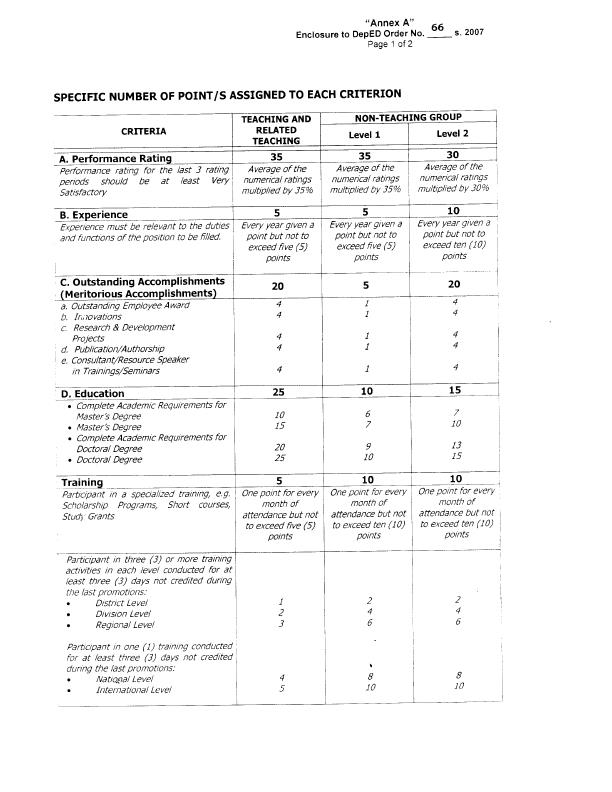
Guidelines and Standards for the Promotion of Different DepEd Positions

CLICK THE LINK TO OPEN THE MEMO/ORDER:

1. Reclassification of School Heads and Principal Positions

2. Guidelines on Selection, Promotion and Designation of School Heads

3. Qualification Standards for Head Teachers and Principals

4. Qualification Standards of Education Program Supervisor (EPS)

5. DEPED Order No. 66, series of 2012.  Guidelines on the Appointment and Promotion of Teaching and Non-Teaching Positions


Qualification Standards of Education Program Supervisor (EPS)


Qualification Standards for Head Teachers and Principals


Guidelines on Selection, Promotion and Designation of School Heads


Guidelines on the Appointment and Promotion of Teaching and Non-Teaching Positions